
Display case not holding temperature
A glass-door or open-air case that reads warm is rarely a single failed part. It is usually the product, the air, and the equipment fighting each other. Here is how to work through the causes in order, from what your staff loaded this morning to what actually needs a technician.
Why is my display case not holding temperature?
A display case that will not hold temperature puts product at risk in plain sight of your customers, which makes it feel like an emergency even when the fix is simple. Open-air merchandisers and glass-door reach-ins depend on a curtain of moving air or a sealed door to keep cold in and room air out, and that balance is easy to disturb without anyone touching a control. Working through the likely causes in order, starting with how the case is loaded, finds most problems before they become a compressor call.
Most warm-running cases trace back to something interrupting the airflow the case was designed around, not a failed compressor. Merchandising equipment holds temperature by circulating a curtain or a steady stream of cold air across the product, and anything that blocks, redirects, or overwhelms that air shows up as a warm reading within hours.
The case is doing its job against the odds
Unlike a sealed walk-in, an open-front case is constantly losing cold air to the room and pulling room air back in. It is engineered to hold temperature under that condition, but only within limits — a case with a failing air curtain, a blocked return, or product stacked past its rating is being asked to do more than it can. The fix is almost never one thing; it is usually two or three small issues compounding.
Start with what changed today
If the case held temperature yesterday and does not today, ask what changed: a delivery loaded in a hurry, a new item stocked at the front, the case left uncovered overnight, or unusually busy foot traffic keeping the doors or curtain disturbed. That answer usually points straight at the cause.
A display case is only ever as good as the air it is fighting against, and in an open storefront that fight never really stops.
United A/C & RefrigerationIs the case simply overloaded?
Yes, more often than any other cause. Every display case has a load line or a marked maximum stocking height, and product piled above it, pushed flush against the back wall, or stacked in front of the return-air grille blocks the exact airflow path the case relies on.
Return air is as important as discharge air
Staff naturally focus on the cold air coming out, but the air has to come back in somewhere. A case with its rear or base return vents packed with boxes or overstock cannot recirculate, so the compressor runs constantly while the front of the case still reads warm.
Depth matters as much as height
Product pulled forward past the case's rated depth breaks the air curtain on an open case, letting cold air spill out and warm air roll in with every passing shopper. Restocking to the marked line, and leaving the return path clear, resolves a surprising share of warm-case calls without anyone touching the refrigeration.
Could the defrost cycle be the problem?
It can, because a coil carrying too much frost cannot move enough air to hold temperature, and the frost is often invisible from the front of the case. Every refrigerated case defrosts on a timed or demand cycle to melt frost off the evaporator coil before it builds up enough to block airflow.
A failed defrost heater, a stuck defrost timer, or a drain that backs up and refreezes lets frost accumulate cycle after cycle until the discharge grille itself is restricted. The case can look normal at a glance while the coil behind the panel is choked. A telltale sign is a case that runs progressively warmer over several days rather than failing suddenly — that gradual slide points at defrost, not a one-time load. This is a technician-level check, since it means pulling a panel to see the coil directly.
What about the doors or the air curtain?
On a glass-door case, worn or torn gaskets let warm, humid room air leak in continuously, and the compressor cannot out-run a steady leak the way it can a brief door opening. On an open-front case, the air curtain itself is the door, and anything that disturbs it — a fan running out of adjustment, an obstruction near the discharge, or simply standing too close for too long — lets it collapse and mix with room air.
Night covers and off-hours
Cases left uncovered overnight, or in a space with the HVAC set back after closing, work much harder to hold temperature by morning. Night covers on open cases, where the equipment is designed for them, meaningfully cut that overnight load. A case that reads fine at close and warm at opening is often telling you about the room overnight, not a fault in the case itself.
Does the room the case sits in matter?
Considerably. A display case is only ever as good as the air it is fighting against. A case near a kitchen pass-through, a front door, direct sun through storefront glass, or a poorly cooled section of the sales floor is pulling in warmer, more humid air than the case was rated for, which pushes the compressor and the defrost cycle harder than normal. A dirty condenser coil on the case's own condensing unit, whether mounted underneath or remotely, compounds the problem by making it harder for the unit to reject the heat it does collect. If several cases in the same area are all trending warm together, the room is very likely the common cause, and it is worth having the equipment and the space evaluated together rather than servicing one case at a time.
Why display cases fight harder here
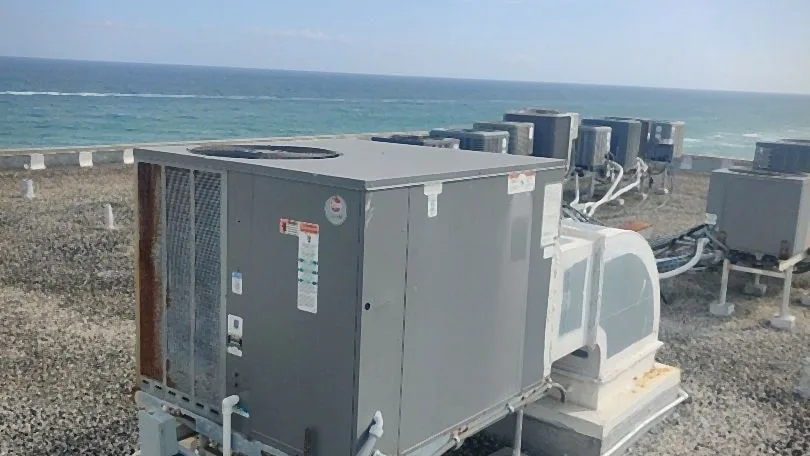
South Florida's humidity is the quiet variable behind a lot of warm-case calls. Every time an open-air curtain mixes with room air, it is pulling in air carrying far more moisture than it would in a drier climate, and that moisture loads the coil with frost faster and drives the defrost cycle harder, which is exactly the mechanism that chokes airflow. Storefronts with doors propped for deliveries or heavy foot traffic make it worse. Salt-laden air near the coast adds a second, slower problem for condensing units mounted outside or on a roof, corroding fins and electrical contacts over time in a way that shows up first as a case that runs a little warmer than it used to, well before anything fails outright. Storm season adds a third layer: a case that loses power for even a few hours during an outage needs its temperature log checked and, if there is any doubt about product safety, a conservative call on what stays and what goes. None of this means a case near the coast or the front door is destined to run warm — it means the loading, the covers, and the maintenance schedule matter more here than they would inland.
Serving Broward County and southern Palm Beach County from our shop in Deerfield Beach.
Questions and answers
Why does my display case read fine in the morning but warm by afternoon?
This pattern usually points at cumulative load rather than a sudden failure: restocking through the day pushes product past the load line, foot traffic disturbs the air curtain repeatedly, and the room itself warms as the day goes on. Check the load line and the return-air path first, since afternoon drift is the classic signature of a case slowly losing the airflow fight.
Can I fix a warm display case myself?
Often, yes, if the cause is loading. Restocking to the marked line, clearing the return-air grille, and checking that gaskets or night covers are in good condition resolves a large share of warm-case complaints without a service call. If temperature does not recover within a few hours of correcting the load, or if you see frost on the glass or discharge grille, it has moved past a merchandising fix.
How do I know if it's the defrost cycle and not the loading?
A defrost problem tends to build gradually over several days rather than appear after one busy shift, and it often shows visible frost at the discharge grille or on the coil behind an access panel. Loading problems, by contrast, usually correlate directly with a delivery or a restock. If correcting the load does not help within a reasonable window, defrost is the next thing to have checked.
Is it safe to keep selling from a case that's running a few degrees warm?
That depends on how warm and for how long, and it is a food-safety judgment call, not a comfort one. A case that has drifted outside its normal holding range for an extended period puts product at risk regardless of how it looks. When in doubt, move product to a case or cooler that is confirmed to be holding temperature and have the warm case looked at before restocking it.
Do open-air cases run warmer than glass-door cases by design?
They run on a different principle, not simply warmer. An open case relies on a moving air curtain instead of a physical door, which trades a small amount of efficiency for merchandising visibility and easy shopper access. Both formats hold their rated temperature reliably when loaded correctly and maintained, but an open case is more sensitive to room conditions, foot traffic, and overloading than a sealed glass door.
Who should I call when a display case won't hold temperature?
Once loading, gaskets, and covers are ruled out, it is time for someone who can inspect the coil, the defrost components, and the condensing unit directly. Tell the assistant what the case is doing, how it is loaded, and whether other cases nearby are affected, and it will help sort a quick adjustment from a repair that needs a technician on site.
How we know this
This advice comes from what our technicians actually find on service calls in Broward County and southern Palm Beach — not from national HVAC copy. Salt-air corrosion on the barrier island, drain lines that block every wet season, and equipment running nine months a year are local realities, and they change the right answer.
Worth disclosing: we install Amana equipment, so we are not an independent reviewer. Where a brand or product is discussed we say what it is good and bad at, and we will tell you when the honest answer is to repair what you have or do nothing yet.
Talk to a technician
Have a question this raised? The assistant answers what it can, takes your details, and hands you to a real person who confirms the day and time.