
Reach-in versus walk-in for a small kitchen
The two most common cold-storage formats work on different principles, and a small kitchen rarely needs to choose only one. Here is an honest comparison of footprint, workflow, and reliability to help you decide what actually fits your space and your service.
What's actually different between a reach-in and a walk-in?
Every small kitchen eventually asks the same question when planning or replacing cold storage: reach-in units on the line, a single walk-in, or some combination of both. The honest answer depends less on which format is objectively better and more on how your kitchen actually operates — how often the doors open, how much bulk product you hold between deliveries, and how much floor space you can spare. Here is what genuinely differs between the two, and where most small operations land.
A reach-in is a self-contained refrigerator or freezer with its own compressor, sized to sit on the cook's line within arm's reach. A walk-in is a built room, insulated and refrigerated as a unit, that staff physically enter to retrieve product. The distinction is not just size; it changes how each one is meant to be used.
Access pattern is the real difference
A reach-in is opened dozens or hundreds of times during a shift for small quantities pulled quickly. A walk-in is opened less often for larger quantities, and staff linger inside stocking or organizing. Each format is engineered around its expected access pattern, which is why using one for the other's job — treating a walk-in like a line reach-in, for instance — tends to disappoint.
They solve different problems
Reach-ins solve the line-access problem: cold product exactly where the line needs it, without a walk to a back room. Walk-ins solve the volume problem: enough bulk capacity to hold deliveries, prep, and overflow without cramming every reach-in past its rated load. Most kitchens need both problems solved, which is part of why the honest answer is often both formats together.
Reach-ins solve the line-access problem and walk-ins solve the volume problem, and most kitchens genuinely need both solved.
United A/C & RefrigerationWhich fits a small kitchen's footprint?
Reach-ins generally win on flexibility in a tight footprint, because they come in single- and multi-section sizes that slot into an existing line layout, and a undercounter or half-height unit can fit spaces a walk-in never could. A walk-in needs a dedicated footprint, adequate ceiling height, and a location the condensing unit can be serviced from, which is a harder ask in a kitchen that was not designed around one.
Retrofitting an existing space
Adding a walk-in to a kitchen that was not built for one is possible but constraining — it usually means giving up storage or prep space elsewhere, and the door swing and condensing unit placement have to work around everything already in the room. Reach-ins retrofit far more easily because they replace, in place, whatever refrigeration is already sitting on the line. If floor space is the binding constraint, that alone often settles the question before workflow or capacity even enter the conversation.
How do they handle a busy service line?
A reach-in built for line duty recovers quickly from frequent short openings, which is exactly what a busy service needs; its smaller internal volume and stronger relative airflow bring the temperature back down fast between openings. A walk-in, opened less often but for longer stretches, is built to hold a large, stable volume of cold air rather than snap back instantly — which is fine for its job, but it is the wrong tool if it is standing in for line reach-ins during a rush.
Where kitchens run into trouble is propping a walk-in door open during service to shuttle product back and forth; that defeats the design on both ends, warming the walk-in and adding travel time the line does not have. If your line genuinely needs product within a step or two, that is a reach-in's job, and no amount of walk-in capacity substitutes for it during a rush.
Is one format a bigger reliability risk than the other?
A single walk-in is a bigger single point of failure than a bank of reach-ins, and that is worth weighing honestly. If a walk-in's compressor or controls fail, every case of product inside it is at risk at once, and there is no redundancy unless the kitchen has a second cold-storage option to shift product into. A kitchen running three or four reach-ins, by contrast, has built-in redundancy: one unit failing affects only what was in it, and product can often be shifted to another unit temporarily while it is repaired.
This is not a reason to avoid walk-ins — their capacity is often essential — but it is a reason to have a real contingency plan for one, whether that is a spare reach-in, a relationship with a nearby kitchen, or simply a fast service response when something goes wrong. A kitchen with only a walk-in and no backup is one compressor failure away from losing everything at once.
Which one is actually cheaper to run?
There is no single answer, because the honest comparison is about surface area, cycling, and use pattern rather than a fixed number. A reach-in has a high ratio of insulated surface to stored volume compared with a walk-in, which works against it per cubic foot of storage; a walk-in's larger, more efficient envelope holds temperature more steadily once loaded. But a walk-in left with an inefficient door seal, propped open during service, or oversized for what a small kitchen actually stores loses that advantage quickly. In practice, the format that runs more efficiently is the one sized correctly for how it is actually used — an oversized walk-in half full of product cycles more than it needs to, and an undersized reach-in forced to work constantly wears out faster than one matched to the load.
What South Florida adds to the decision
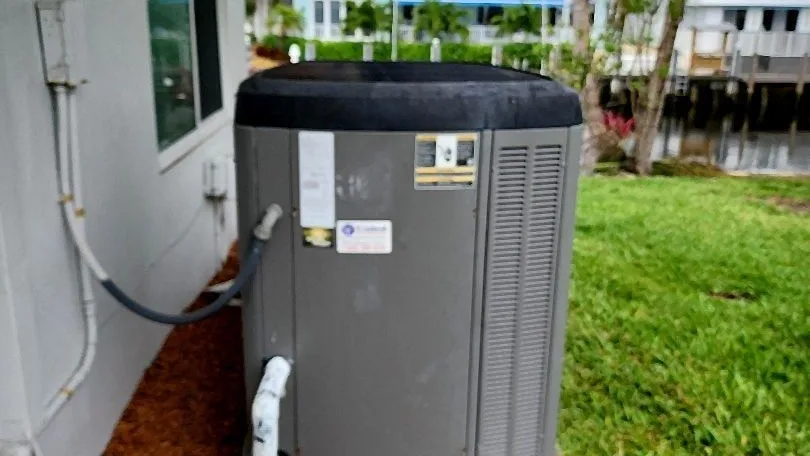
Heat and humidity change the calculus for both formats here more than in a milder climate. A walk-in's remote condensing unit, whether on a roof or against an exterior wall, works against South Florida's ambient heat for most of the year, and salt-laden air near the coast accelerates corrosion on its coils and electrical contacts the same way it does on any outdoor cooling equipment. Reach-ins, sitting indoors and depending on the kitchen's own air conditioning to keep their surrounding air within range, suffer instead when the kitchen HVAC falls behind on a brutal afternoon, forcing every reach-in on the line to work harder at once. Storm season is the other local factor worth planning around: a walk-in holds a large volume of product through a short power outage better than an equivalent amount spread across several smaller reach-ins, simply because of its greater thermal mass, which is a real point in its favor if outages are a recurring concern for your location. A generator sized to carry critical refrigeration through a storm-driven outage is worth planning regardless of which format you rely on, and it is worth discussing as part of any new installation rather than an afterthought.
Serving Broward County and southern Palm Beach County from our shop in Deerfield Beach.
Questions and answers
Can a small kitchen operate with only reach-ins and no walk-in?
Yes, and many do, particularly where delivery frequency is high and bulk storage needs are modest. The tradeoff is less buffer between deliveries and less resilience if a delivery is delayed. If your kitchen already receives product several times a week and does not hold large quantities of raw inventory, an all-reach-in setup can work well and is simpler to retrofit into an existing space.
Is a walk-in worth it for a small kitchen if space is tight?
It depends on how much bulk storage your menu and delivery schedule actually require. A walk-in earns its footprint when a kitchen holds significant raw inventory, preps in large batches, or receives deliveries infrequently. If space is genuinely tight and deliveries are frequent, a well-planned bank of reach-ins may deliver more usable storage per square foot than a walk-in squeezed into an undersized footprint.
How much floor space does a small walk-in actually need?
Beyond the footprint of the box itself, plan for door swing clearance, service access to the condensing unit, and enough surrounding space that staff are not maneuvering carts through a bottleneck. It adds up to noticeably more than the walk-in's interior dimensions suggest on paper, which is the most common surprise for kitchens retrofitting one into existing space.
Do reach-ins or walk-ins need more maintenance?
Both need regular attention, but the failure modes differ. Reach-ins have more individual compressors and door gaskets across a kitchen, so there is more equipment to check, but a single failure is contained. A walk-in has one refrigeration system serving a much larger space, so its condensing unit, evaporator, and door seal deserve close attention since a lapse there affects everything stored inside at once.
What happens if my only walk-in goes down mid-service?
It becomes an emergency quickly, since there is typically no backup for everything stored inside. Having a documented plan — where product can be shifted temporarily, ice on hand, and a fast route to service — matters more for a single walk-in than for a bank of reach-ins, where the exposure of any one failure is naturally smaller.
Should I plan a mix of reach-ins and a walk-in for a new kitchen?
For most small kitchens, yes, and it is worth working through with someone who can look at your menu, delivery schedule, and floor plan together rather than choosing a format first and fitting the kitchen around it. Tell the assistant about your space and how you operate, and it will help you think through what combination actually fits.
How we know this
This advice comes from what our technicians actually find on service calls in Broward County and southern Palm Beach — not from national HVAC copy. Salt-air corrosion on the barrier island, drain lines that block every wet season, and equipment running nine months a year are local realities, and they change the right answer.
Worth disclosing: we install Amana equipment, so we are not an independent reviewer. Where a brand or product is discussed we say what it is good and bad at, and we will tell you when the honest answer is to repair what you have or do nothing yet.
Talk to a technician
Have a question this raised? The assistant answers what it can, takes your details, and hands you to a real person who confirms the day and time.