
Scheduling work around trading hours
A restaurant, a retail floor, or a clinic cannot simply close for an afternoon so a technician can work. Here is how commercial HVAC and refrigeration service actually gets scheduled around a business that has to stay open.
Can HVAC service really happen without closing?
The question we hear most from business owners is not whether their rooftop unit or walk-in can be serviced, but whether it can be serviced without touching the hours the business actually makes money. It almost always can. Commercial cooling equipment fails and ages on its own schedule, not the business's, so the scheduling problem is really a coordination problem: matching the work that needs doing to a window when doing it costs nothing. Some of that window is obvious — before open, after close — and some of it is specific to how a given operation runs, which is why the first real step is understanding the business, not the equipment.
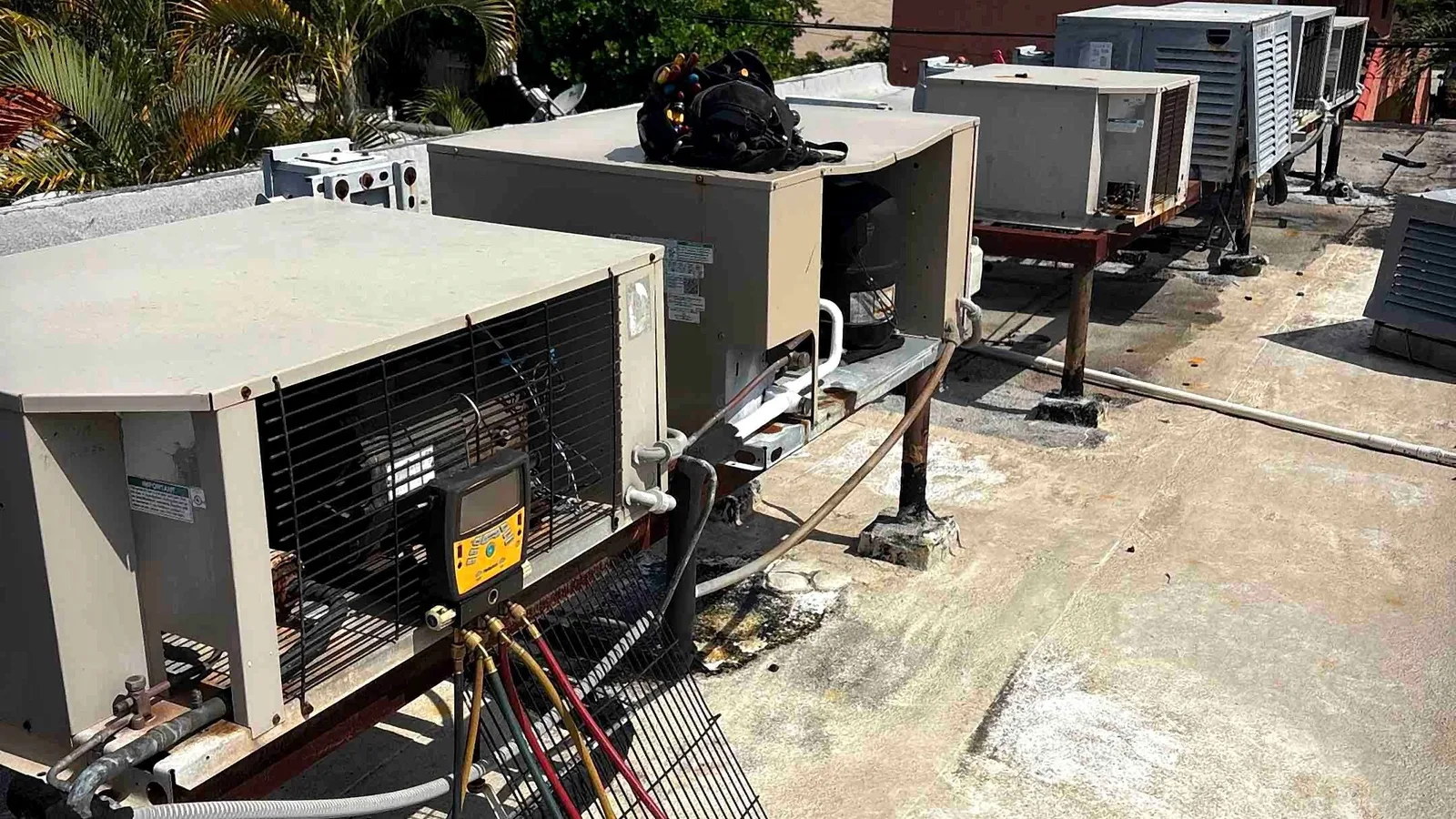
Yes, for the large majority of commercial work, because most of what a cooling system needs does not require the space to be empty. Filter changes, coil cleaning, refrigerant checks, and belt or bearing inspections on a rooftop unit happen on the roof or in a mechanical room, out of sight of customers or staff.
What genuinely needs a quiet building
A handful of jobs are easier, or safer, with reduced foot traffic underneath — running new ductwork, replacing an air handler in a ceiling plenum over a dining room, or any work that involves ladders and open panels directly above where people sit. Even then, the honest answer is usually a slow window rather than a full closure: early morning for a restaurant before the lunch rush, a Sunday morning for a retail space, overnight for a 24-hour operation's non-critical zones.
Emergencies do not wait for a good time
A rooftop unit that fails on a 95-degree afternoon with a dining room full of customers is not a scheduling conversation, it is an urgent call, and we treat it that way regardless of what time it lands. The scheduling discussion is for planned work — maintenance, replacements, upgrades — where there is room to choose the window.
The scheduling problem is really a coordination problem: matching the work to a window when doing it costs the business nothing.
United A/C & RefrigerationWhat is the difference between HVAC and refrigeration urgency?
Comfort cooling and refrigeration fail on very different clocks, and that difference should drive how you schedule around each.
Comfort HVAC has some slack
A commercial space that loses cooling gets uncomfortable, and past a point it affects staff and customers, but it rarely destroys inventory in the first hour. That gives some room to schedule the fix for the next practical window rather than treating every warm afternoon as a five-alarm event, though a sustained outage in South Florida heat still deserves same-day attention.
Refrigeration has almost none
A walk-in cooler, a reach-in case, or an ice machine that fails starts costing product immediately, and the cost compounds every hour the temperature climbs. A bar's keg cooler, a convenience store's open cases, a restaurant's walk-in — these get triaged ahead of comfort calls because the loss is not comfort, it is inventory that cannot be recovered. If you operate commercial refrigeration, it is worth having a plan for who gets called the moment a unit drifts warm, before it turns into a full refrigeration emergency.
Building the distinction into your plan
Knowing which of your systems are comfort and which are refrigeration lets you set expectations correctly: comfort issues can often wait for a scheduled slot, refrigeration issues should never wait.
How do you schedule around a business that never fully closes?
The starting point is telling us the actual rhythm of the operation, not just an address. A bar's slow window is a Tuesday morning; a clinic's is a Saturday; a 24-hour store may not have a slow window at all, only a less-busy one. Once we know that, planned work — a maintenance visit, a compressor swap, a full system replacement — gets scoped into it.
Staging the work in pieces
Larger jobs, like replacing a rooftop unit over an occupied space, often get staged: prep and any exterior work happen during normal hours since they do not touch the interior, and the disruptive portion — the changeover itself — gets compressed into the shortest possible closed window, sometimes overnight, so the system is live again before the next open. This is standard practice for commercial replacement work and it is worth asking about explicitly when you get a quote.
Multiple locations, one coordinated approach
If you run more than one site, staggering visits across locations rather than all at once keeps at least one site fully staffed and unaffected at any given time, and lets a single crew work through a route efficiently. A standing multi-site maintenance contract is usually what makes that staggered routing possible in the first place, rather than re-planning it from scratch each time.
What should you tell us before booking?
A short list of details turns a generic appointment into a scheduled visit that actually respects your hours. Your slowest window in a normal week, whether the equipment is accessible from outside or only through occupied space, whether any of it is refrigeration that cannot tolerate delay, and whether staff or a manager needs to be present for access all change how a visit gets planned.
It also helps to flag recurring constraints once rather than every time — a kitchen that cannot lose power during dinner service, a server room above a dropped ceiling that cannot go without cooling for more than a few minutes, a walk-in that has to stay above a certain temperature for a food-safety inspection window. Once that context is on file, every future visit gets planned around it automatically rather than re-litigated on the phone. Businesses that keep a standing maintenance plan in place tend to have the smoothest experience here, because the routine visits are already pre-scheduled into a rhythm that works for them.
What South Florida trading hours mean for scheduling
South Florida's commercial mix runs unusually long hours for much of the year. Restaurants and bars along the coast serve into the night through the winter season crowds; convenience stores and gas stations near the highway corridors often never close; medical offices in Broward's dense professional parks run tight, fully booked days with almost no dead time. That reality shapes how we schedule around this market specifically. A rooftop unit over a Fort Lauderdale restaurant's dining room is a different scheduling problem than the same unit over a Boca-area office suite that empties out by six, and a crew working the coastal corridor plans routes with that variance in mind rather than assuming every business runs a normal nine-to-five. The heat load itself adds pressure too: South Florida's long cooling season means a comfort system rarely gets a truly slow month to defer work into, so planning ahead of the next heat stretch, rather than reacting to it, matters more here than in a climate with a real off-season. Whatever your hours look like, telling us up front is what lets a visit fit into your business instead of around it.
Serving Broward County and southern Palm Beach County from our shop in Deerfield Beach.
Questions and answers
Can you service a rooftop unit without anyone noticing?
Often, yes. Rooftop and exterior equipment can usually be accessed and serviced without a technician ever entering the occupied space, so routine maintenance can happen during business hours with zero disruption to customers or staff on the floor. Interior work is the exception, and that gets scheduled around your slow windows instead.
What if our business genuinely never has a slow period?
That is common with convenience stores, some restaurants, and round-the-clock operations, and it still works. We plan around the least-busy stretch rather than a true closure, stage disruptive work to be as brief as possible, and coordinate directly with a manager on site so the visit fits into the flow of the day rather than stopping it.
How fast can you respond if our walk-in cooler fails during service?
Refrigeration failures are treated as urgent because product loss starts immediately and compounds by the hour. Call as soon as you notice the drift rather than waiting to see if it corrects itself, and tell the assistant what the unit is doing so the visit gets prioritized correctly from the start.
Do you charge more for after-hours or overnight work?
Scheduling specifics and any after-hours considerations are worked out when you book, not published as a flat policy here, since every business's situation is different. Ask the assistant or our team directly and you will get a straight answer for your circumstances before anything is scheduled.
Can maintenance be scheduled as a standing routine instead of one call at a time?
Yes, and it is usually the better approach for a business with predictable hours. A standing maintenance plan lets us pre-schedule routine visits into your known slow windows so they never require a new negotiation each time, and it also tends to catch small problems before they become the kind of failure that cannot wait.
What should I have ready when I call about scheduling?
Your typical slow window during a normal week, whether the equipment is reachable without entering occupied space, whether any of it is refrigeration, and who on site can grant access. With those details on file, a visit gets planned around your business the first time, not worked out on the fly.
How we know this
This advice comes from what our technicians actually find on service calls in Broward County and southern Palm Beach — not from national HVAC copy. Salt-air corrosion on the barrier island, drain lines that block every wet season, and equipment running nine months a year are local realities, and they change the right answer.
Worth disclosing: we install Amana equipment, so we are not an independent reviewer. Where a brand or product is discussed we say what it is good and bad at, and we will tell you when the honest answer is to repair what you have or do nothing yet.
Talk to a technician
Have a question this raised? The assistant answers what it can, takes your details, and hands you to a real person who confirms the day and time.