
Condo association rules and AC repairs
A condo AC repair can involve your unit, a common wall, a balcony, and a set of association rules all at once. Here is generally how responsibility and approval tend to split, and what to confirm before you schedule anything.
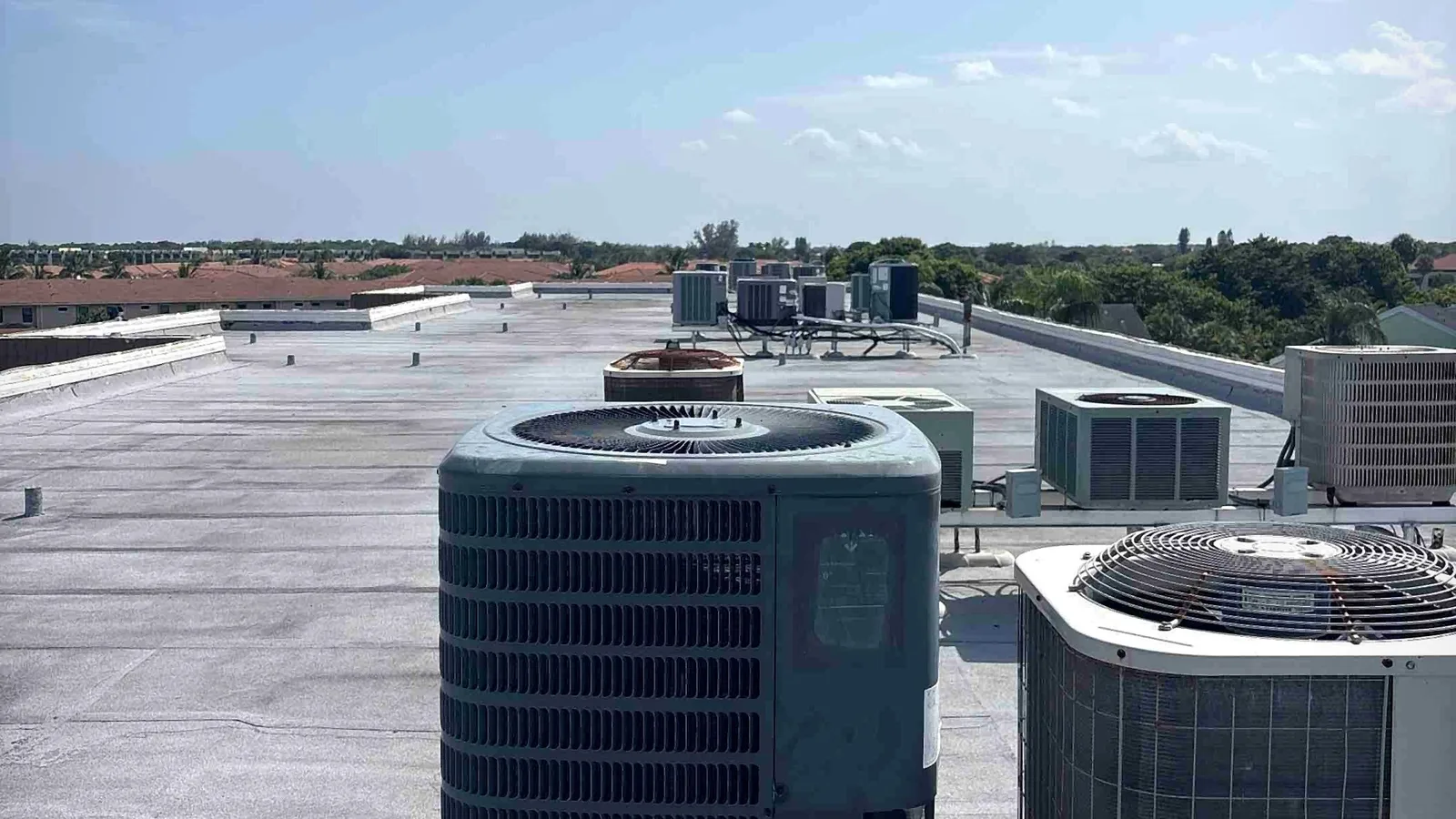
Is my AC condenser a common element or part of my unit?
Condo living adds a layer that a single-family home never has to deal with: an association with rules about what you can do to the outside of your unit, and a declaration document that decides what counts as yours in the first place. Air conditioning sits right in the middle of that, because the equipment usually spans both worlds — an indoor air handler that is unambiguously yours, and an outdoor condenser or rooftop connection that may or may not be. The general patterns below hold across most South Florida condos, but the declaration for your specific building is the document that actually governs, and it is worth pulling out before a repair turns into a dispute. If you rent rather than own, responsibility shifts again — see landlord and tenant AC responsibilities in Florida for how that split generally works.
In most low-rise and townhouse-style condos, the condenser sitting in a yard, on a pad, or on a private balcony is treated as part of the unit, meaning the owner is responsible for its repair and replacement. The line gets less clear in mid-rise and high-rise buildings, where condensers sometimes sit on a shared roof, in a mechanical room, or on a ledge that is technically a limited common element — space assigned for one owner's exclusive use but still owned collectively by the association.
Why the distinction matters
A limited common element usually still makes the owner responsible for maintaining the equipment on it, but the association may have more say over access, appearance, and the timing of work, since it touches the building's shared exterior. A true common element, like a rooftop chiller or a shared mechanical room serving several units, generally shifts both cost and decision-making toward the association rather than any single owner.
Where to actually find the answer
The declaration of condominium for your building states this explicitly, usually in the section defining units, limited common elements, and common elements. It is worth a read before assuming either way, since buildings genuinely differ.
The declaration of condominium, not a general assumption about how condos work, is what actually decides who is responsible.
United A/C & RefrigerationDo I need approval before repairing or replacing my AC?
Often, yes, for anything that changes the exterior appearance, requires roof or wall penetration, or involves equipment visible from outside the unit, even if the equipment itself is yours to maintain. A straightforward repair — a capacitor, a contactor, a refrigerant leak fixed in place — typically does not require sign-off, since nothing about the unit's footprint or appearance changes. A full replacement is more likely to trigger a notice or approval requirement, especially if the new equipment differs in size, color, or placement from what was there.
Many associations ask for advance notice purely so building management knows a technician will be on site, working near shared walkways, or accessing a roof. That is generally a courtesy and safety matter more than a design review, and it is usually the fastest kind of approval to get. Check your association's architectural review or maintenance request process before scheduling, since a delay caused by a missed notice step is entirely avoidable.
Can the association restrict where a new unit goes or what it looks like?
Yes, in buildings where the exterior is governed by the association's architectural standards, which is common in South Florida condos and many 55-plus communities. Restrictions typically cover placement (keeping units off certain balconies or facades), screening (louvers or fencing to hide equipment from view), and sometimes noise limits for the outdoor unit. These rules exist to keep a building's exterior consistent, not to make repairs harder, but they can add a step to a replacement that a single-family homeowner would not face.
If your building has these standards, the practical move is to get the association's requirements in writing before a technician orders equipment, since matching a replacement to an approved footprint the first time avoids a second trip.
Who is responsible if an AC leak damages a neighboring unit?
Generally, the owner whose equipment or unit caused the leak, though how the cost actually gets allocated can depend on your association's insurance structure and Florida's condominium insurance framework, which is more particular about interior water damage than most general guides can responsibly summarize. A condensate line that backs up and drips into the unit below, or a coil pan that overflows, is a common source of this kind of dispute in stacked condo buildings.
The practical takeaway is that both a working condensate drain and a documented, professional repair history matter more in a condo than in a standalone house, since they are the evidence that separates routine maintenance from negligence if a dispute over damage ever comes up. If you are unsure who is on the hook after a leak, that is a conversation for your association and, if needed, your insurance provider — not something to guess at.
Why South Florida condos add their own wrinkle
Condo and 55-plus communities are a huge share of the housing stock from the coast inland through Broward and southern Palm Beach, and a lot of that stock is older mid-rise construction built well before current building standards. Salt air off the ocean and the intracoastal accelerates corrosion on any equipment mounted outside, which matters twice in a condo: it shortens the life of the unit itself, and it can affect shared structural elements like railings, ledges, and roof penetrations that the association is separately responsible for maintaining. That overlap is why associations near the coast tend to be more particular about AC work than inland buildings — a leaking roof penetration from a poorly sealed line set is a shared-building problem, not just a unit problem. It is also why timing matters here more than most places: condo boards and property managers get a wave of AC service requests every summer as older buildings' equipment reaches the end of a shortened, salt-air life, and getting on a schedule before peak season avoids both the wait and the risk of running a failing system through a Florida August.
Serving Broward County and southern Palm Beach County from our shop in Deerfield Beach.
Questions and answers
Is my AC condenser a common element or part of my unit?
It depends on your building. In most low-rise and townhouse-style condos, the condenser is part of the unit and the owner's responsibility. In mid-rise and high-rise buildings, it can sit on a limited common element or even a true common element like a shared roof, which shifts more of the decision-making toward the association. Your declaration of condominium states this explicitly for your building.
Do I need HOA or association approval to replace my AC?
Often for anything that changes the exterior appearance, footprint, or involves roof or wall access, even if the equipment itself is yours to maintain. A straightforward repair usually does not need approval. Check your association's architectural review process before scheduling a replacement so a missed notice step does not delay the work.
Who pays if my AC leak damages the unit below me?
Generally the owner whose equipment caused the leak, but how the cost is actually allocated can depend on your association's insurance structure and Florida's condominium insurance rules, which get particular about interior water damage. This is a question for your association and insurance provider in any real dispute, not something to assume generally.
Can the association make me use a specific contractor or brand?
Rarely for the repair itself, but associations with architectural standards can restrict placement, screening, and sometimes noise limits for outdoor equipment. They generally cannot force a specific brand for equipment inside your unit's responsibility, though it is worth checking your declaration and any recorded rules, since buildings genuinely differ.
What if my building has a central or shared AC system instead of individual units?
Some larger or older high-rises use a central chiller or a shared mechanical system rather than individual condensers, and in that setup, the association typically owns both the cost and the repair decision, since no single owner controls the equipment. If you are unsure which setup your building has, your property manager can tell you quickly.
Can the association restrict when repair work can be done?
Many associations do set reasonable hours for contractor work and noise, and some require advance notice so building staff know when a technician will be on site or accessing a roof. This is usually a scheduling courtesy rather than a real obstacle, and building it into your repair timeline avoids a wasted trip.
How we know this
This advice comes from what our technicians actually find on service calls in Broward County and southern Palm Beach — not from national HVAC copy. Salt-air corrosion on the barrier island, drain lines that block every wet season, and equipment running nine months a year are local realities, and they change the right answer.
Worth disclosing: we install Amana equipment, so we are not an independent reviewer. Where a brand or product is discussed we say what it is good and bad at, and we will tell you when the honest answer is to repair what you have or do nothing yet.
Talk to a technician
Have a question this raised? The assistant answers what it can, takes your details, and hands you to a real person who confirms the day and time.