
Keeping maintenance records for warranty claims
A denied warranty claim rarely comes down to whether the maintenance happened. It comes down to whether you can prove it did. Here is what documentation manufacturers actually look for, what to keep, and how to avoid finding this out the hard way.
Why do manufacturers require maintenance records at all?
Most homeowners think of a warranty as something that simply exists once a new system is installed, sitting quietly in the background in case something fails. In practice, a large share of manufacturer warranties are conditional: coverage depends on the system being maintained on a regular, documented schedule, and if a claim is filed without proof that happened, it can be reduced or denied regardless of whether the failed part was genuinely defective. None of this is exotic or unusual — it is simply a condition worth understanding before you need it, and it is one of the easiest things to get right if you know what to keep.
A manufacturer's warranty covers a defect in the equipment, not damage caused by neglect, and documented maintenance is how the manufacturer distinguishes between the two. A compressor that fails because of a manufacturing flaw is a warranty claim. The same compressor failing because refrigerant was never checked, the coil was never cleaned, and airflow was restricted for years is, from the manufacturer's side, a maintenance failure rather than a product failure — even if the part itself would otherwise have been covered.
This is a standard structure across the industry, not a quirk specific to one brand, and the exact terms vary by manufacturer and by the specific warranty on a given system. We are an Amana dealer that services all brands, and rather than guess at another manufacturer's fine print, the right move is always to check the warranty documentation that came with your specific system, or ask the assistant to help you find what your particular coverage requires.
A failure the warranty was built to cover and a failure the paperwork cannot prove happened produce the exact same bill.
United A/C & RefrigerationWhat actually counts as acceptable proof of maintenance?
Acceptable documentation is specific, and vague memory of service does not hold up to a claim review.
What a valid record includes
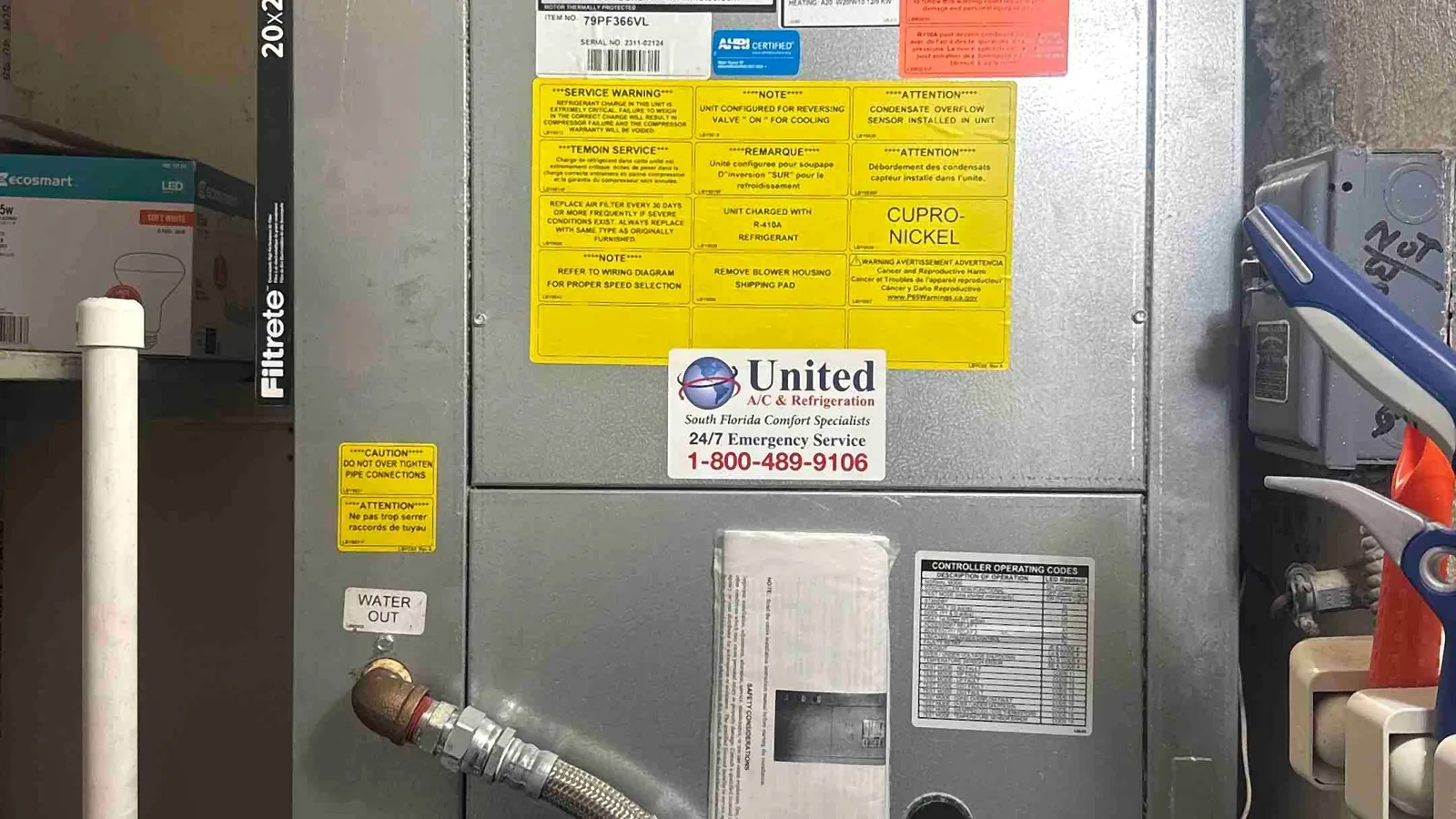
A dated invoice showing the company's name and license number, the technician who performed the work, what was actually done — not just "AC serviced" but the specific checks and parts involved — and the system's model and serial number is the standard a manufacturer expects to see. A stack of invoices that clearly correspond to the covered system, spaced roughly every six months to a year, is what a claims reviewer is looking for.
What tends to fall short
A handwritten note, a text message confirming an appointment, or a memory of having someone come out generally will not satisfy a manufacturer's documentation requirement. Cash payments to an unlicensed individual with no invoice leave nothing to submit at all, which is one more reason licensed, invoiced professional maintenance is worth the habit even before a claim ever comes up.
What should you actually keep, and for how long?
Keep everything tied to the system for as long as the warranty could plausibly apply, which for most modern systems is measured in years, not months.
The core file
Every service invoice from every visit, the original installation paperwork and permit, and the system's model and serial numbers belong in one place — a folder, a drawer, or a photo album on your phone all work, as long as it is somewhere you will actually find it years later. It is worth keeping this file for as long as any part of the warranty could still be active, since parts coverage on modern equipment commonly extends well beyond the first few years.
Digital backups are worth the five minutes
A photo of each invoice, saved anywhere that survives a phone upgrade — email, cloud storage, a shared drive — protects against the more common failure mode, which is not that maintenance was skipped but that the paper simply got lost in a move, a renovation, or a decade of drawers.
What actually happens if a claim is denied for missing records?
The practical result is that the cost the warranty would have covered — often a significant compressor or coil replacement — falls entirely on the homeowner instead, on top of whatever the diagnostic and labor would have cost either way. This is the scenario that makes recordkeeping worth taking seriously: the maintenance itself may have genuinely happened, faithfully and on schedule, but if it cannot be shown to the manufacturer's satisfaction, the outcome is the same as if it never occurred. It is a frustrating way to lose a claim precisely because it is entirely preventable, and it tends to surface at the worst possible moment — when a major component has already failed and the homeowner is counting on the coverage they believed they had.
How does United help homeowners stay on top of this?
Every maintenance and repair visit we perform generates a dated, itemized invoice under our license, tied to the address and the system serviced — the exact format a warranty claim needs. For customers on a regular schedule, that invoice history builds itself automatically over the life of the system, so keeping records and simply having the maintenance done end up being the same visit rather than two separate chores. If you switch companies, move into a home with an unclear service history, or just want to know what a specific claim would require, the assistant can help you sort out what you already have and what still needs tracking down.
Why this matters a little more in South Florida
A few local realities make good records more valuable here than in a milder climate. Systems in Broward and southern Palm Beach run harder and longer than equipment elsewhere in the country, which means components reach the wear points a warranty is meant to cover sooner, and claims get filed more often over a system's life simply because the equipment works harder. Homes also change hands frequently in this market, and a new owner inheriting a system without the prior owner's service history is common — worth asking for at closing, and worth starting fresh if it is missing. Coastal salt exposure adds a separate wrinkle: a coil or electrical failure caused by corrosion is generally treated as an environmental issue rather than a manufacturing defect, so it is worth understanding that a maintenance record protects against a workmanship or parts claim, not against the ordinary effects of salt air, which is really a maintenance-and-equipment-selection conversation rather than a warranty one. And after a storm, it is worth keeping any storm-related repair paperwork separate from routine maintenance records, since insurance claims and manufacturer warranty claims are different processes with different documentation needs.
Serving Broward County and southern Palm Beach County from our shop in Deerfield Beach.
Questions and answers
Does every new AC system come with a warranty that requires maintenance records?
Most manufacturer warranties on modern systems include a maintenance requirement of some kind, though the specific terms vary by brand and by the individual warranty registered on your system. Check the documentation that came with your installation, or ask the assistant to help you find what your specific coverage requires rather than assuming one standard applies to every system.
What if I've lost an old service invoice?
Contact the company that performed the work first; many keep records on file for years and can reissue a copy. If the company is no longer in business or the invoice truly cannot be recovered, a documented, consistent pattern of other invoices around it still helps your case, even if one visit in the sequence is missing.
Is a third-party home warranty the same as a manufacturer's warranty?
No, they are different things with different rules. A manufacturer's warranty comes from the equipment maker and typically covers specific parts for a set period, often conditioned on maintenance. A third-party home warranty is a separate service contract you purchase, with its own terms, exclusions, and claims process. Keep records for both if you carry both, since they are not interchangeable.
Do I need the original installation paperwork, or just service records?
Both, ideally. The installation paperwork establishes the system's age, model, and original warranty registration, which a claim reviewer needs to confirm coverage exists at all. The service records then show that coverage has been maintained. Missing the installation paperwork does not necessarily end coverage, but it makes a claim harder to process quickly.
I bought my home and don't have the previous owner's AC records. What now?
Ask the seller or their agent before closing if possible; not every warranty transfers to a new owner, and some require notifying the manufacturer of the ownership change. If records genuinely cannot be found, start your own maintenance history from today's date and keep it consistent going forward — and have a technician assess the system's actual condition rather than assuming its history.
If I've used United before, can you look up my service history?
Yes. Every visit we perform is logged under your address and system, so if you have used us previously, that history exists on our side even if you cannot locate your own copies. Ask the assistant or give us a call with your address and we can help pull together what you need for a claim.
How we know this
This advice comes from what our technicians actually find on service calls in Broward County and southern Palm Beach — not from national HVAC copy. Salt-air corrosion on the barrier island, drain lines that block every wet season, and equipment running nine months a year are local realities, and they change the right answer.
Worth disclosing: we install Amana equipment, so we are not an independent reviewer. Where a brand or product is discussed we say what it is good and bad at, and we will tell you when the honest answer is to repair what you have or do nothing yet.
Talk to a technician
Have a question this raised? The assistant answers what it can, takes your details, and hands you to a real person who confirms the day and time.