
Questions to ask before you sign
A cooling contract is easy to sign in the moment and hard to unwind later. These are the questions worth asking before you do, and what a straight answer to each should sound like.
What should I ask about licensing and insurance?
Most of the questions that protect a homeowner during an AC replacement never come up naturally in a sales conversation, because the conversation is usually steered toward the equipment and the schedule. The questions that actually matter sit slightly to the side of that: who is doing the work, how the size was decided, what happens if something goes wrong, and what is written down versus promised out loud. Asking them before you sign costs nothing and takes a few minutes. Not asking them is how a homeowner ends up with a system that was never sized for the house, installed by a subcontractor nobody vetted, with a warranty that turns out to be shorter than assumed.
Ask directly for the contractor's Florida license number and confirm it is current, since Florida requires state licensing to design, install, or service cooling equipment, and the license status is public information. Ask for proof of general liability and workers' compensation insurance as well; if a worker is injured on your property and the company carries no coverage, the exposure can fall back on the homeowner. A company confident in its standing will produce both without treating the request as unusual.
Who is actually doing the work
Ask whether the crew on your job is employed directly or subcontracted, and if subcontracted, whether that company is independently licensed and insured. It changes nothing about your right to a proper installation, but it changes who is accountable if the work is wrong.
The questions that protect you are the ones that never come up on their own in a sales conversation — ask them anyway.
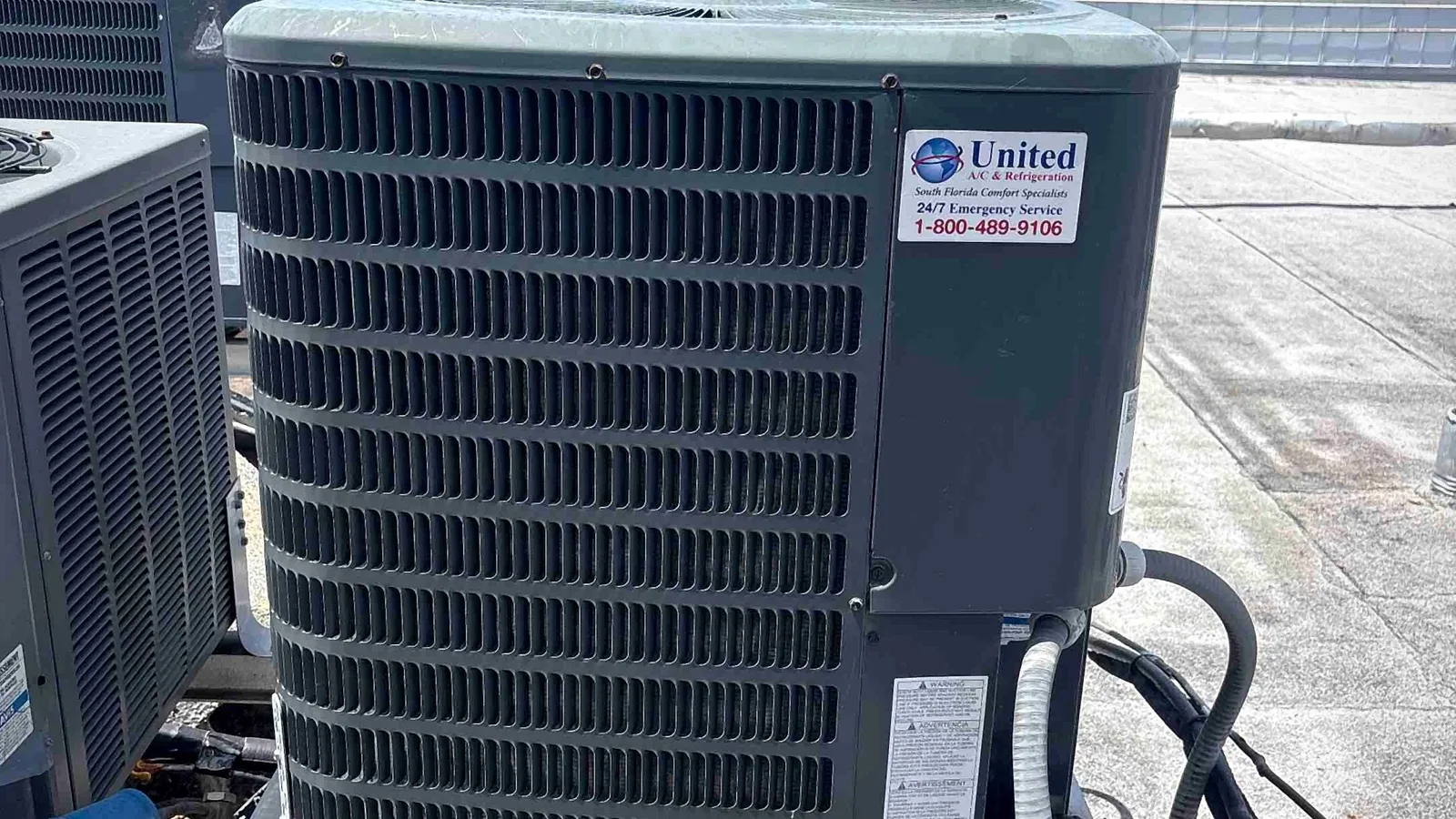
United A/C & RefrigerationWhat should I ask about the equipment being proposed?
Ask how the proposed size was determined, whether it came from a load calculation specific to your home or was matched to the tonnage of the system being replaced. The two can produce different answers, especially if the house has been added onto, re-insulated, or had windows replaced since the original system went in. Ask what efficiency tier is being quoted and whether a comparison to another tier is available, so you are choosing rather than accepting a default.
Match to the rest of the system
If only the outdoor unit or only the indoor coil is being replaced rather than the full system, ask specifically how the new piece is matched to the part staying in place. A mismatched pairing can underperform even when both pieces are individually sound equipment.
What should I ask about the installation itself?
Ask what the installation actually includes beyond setting the equipment in place: will the line set be replaced or reused, will the refrigerant charge be verified against the manufacturer's specification rather than assumed, will airflow be measured after startup. Ask how long the job is expected to take and how many people will be on site, since a realistic answer to both is a sign the scope has actually been thought through.
What happens to the old system
Ask whether removal and disposal of the old equipment is included, and where it goes. It is a small question with an easy answer from anyone who has actually planned the job, and a vague one from anyone who has not.
Ask to see the equipment before it goes in
A reasonable request is to see the model information for the equipment being installed once it arrives on site, so what shows up matches what was quoted. Substitutions happen for legitimate supply reasons, but you are entitled to know if the exact unit you agreed to has changed, and why.
What should I ask about permits and inspections?
Ask whether a mechanical permit will be pulled for the job and who is responsible for scheduling the final inspection. Both Broward County and Palm Beach County require a permit and inspection for a full system replacement, and skipping it, even if the equipment runs fine, can create problems later, from insurance questions to trouble at resale. A contractor who treats this as optional or unnecessary is a reason to ask more questions, not fewer.
Timing around the inspection
Ask roughly how long after installation the inspection typically happens, so you know when the job is genuinely finished rather than just running.
What should I ask about warranty and follow-up?
Ask what the manufacturer's parts warranty covers, how long it runs, and whether the contractor will handle registering it; missing that step can shorten the coverage without you knowing until you need it. Separately, ask what labor warranty the installer offers on their own work, since that is a different promise from the manufacturer's and is worth having in writing rather than assumed to match. Ask what the follow-up process looks like if something needs adjusting in the first weeks after installation; a startup visit or a courtesy check is common practice, not an extra favor.
What is worth asking specifically in South Florida?
A few of these questions carry more weight here than they would in a milder climate. Because the season stretches from spring into the heart of hurricane season, ask about scheduling flexibility if a storm is forecast during your installation window; a contractor who has planned around Florida's weather will have a straightforward answer, not a shrug. If the home sits near the coast, ask specifically whether the proposed equipment includes corrosion-resistant coatings or coastal-rated components, since salt air shortens the working life of an outdoor unit measurably compared with one installed further inland. It is also worth asking which county's permitting process applies to your address, since Broward and southern Palm Beach run separate mechanical permit systems with their own timelines, and an installer who works across both should be able to explain the difference without hesitation. None of these questions require you to know anything technical going in; they simply make sure the answers you get account for the climate the system actually has to survive.
Serving Broward County and southern Palm Beach County from our shop in Deerfield Beach.
Questions and answers
Is it rude to ask a contractor for their license number?
No, and a reputable one will not treat it that way. Florida requires state licensing for HVAC work, and the number is public information you can verify independently. Asking for it, along with proof of insurance, is a normal and expected part of hiring anyone to work on your home.
Should I get more than one quote before signing?
It is generally worth it, mainly so you can compare the answers to these questions rather than just the price. If one contractor answers clearly and another is vague about licensing, sizing, or permitting, that gap tells you more than a lower number does.
What if a contractor says permits are not necessary for my job?
Treat that as a reason to ask more questions. A full system replacement in Broward or southern Palm Beach typically requires a mechanical permit and inspection, and a contractor who dismisses that either misunderstands the requirement or intends to skip it, and neither is reassuring.
How do I know if the proposed system is the right size?
Ask whether it came from a load calculation specific to your home rather than a match to the old unit's size. If additions, insulation upgrades, or new windows have changed the house since the original system was installed, the old size may no longer be correct, and a contractor should be able to walk you through how they arrived at the new one.
What should I do if a contractor pressures me to sign the same day?
Slow down. A legitimate proposal does not usually depend on an immediate signature, and it is reasonable to take a written quote and think it over, especially for a decision you will live with for well over a decade. If a same-day discount is the only reason being offered to rush, weigh that against getting the scope and terms right.
Can the assistant help me prepare questions for a specific quote?
Yes. Describe the job you are getting quoted, whether a full replacement, a single component, or a ductless addition, and the assistant can help you put together the specific questions worth asking for that situation before you sign anything.
How we know this
This advice comes from what our technicians actually find on service calls in Broward County and southern Palm Beach — not from national HVAC copy. Salt-air corrosion on the barrier island, drain lines that block every wet season, and equipment running nine months a year are local realities, and they change the right answer.
Worth disclosing: we install Amana equipment, so we are not an independent reviewer. Where a brand or product is discussed we say what it is good and bad at, and we will tell you when the honest answer is to repair what you have or do nothing yet.
Talk to a technician
Have a question this raised? The assistant answers what it can, takes your details, and hands you to a real person who confirms the day and time.